
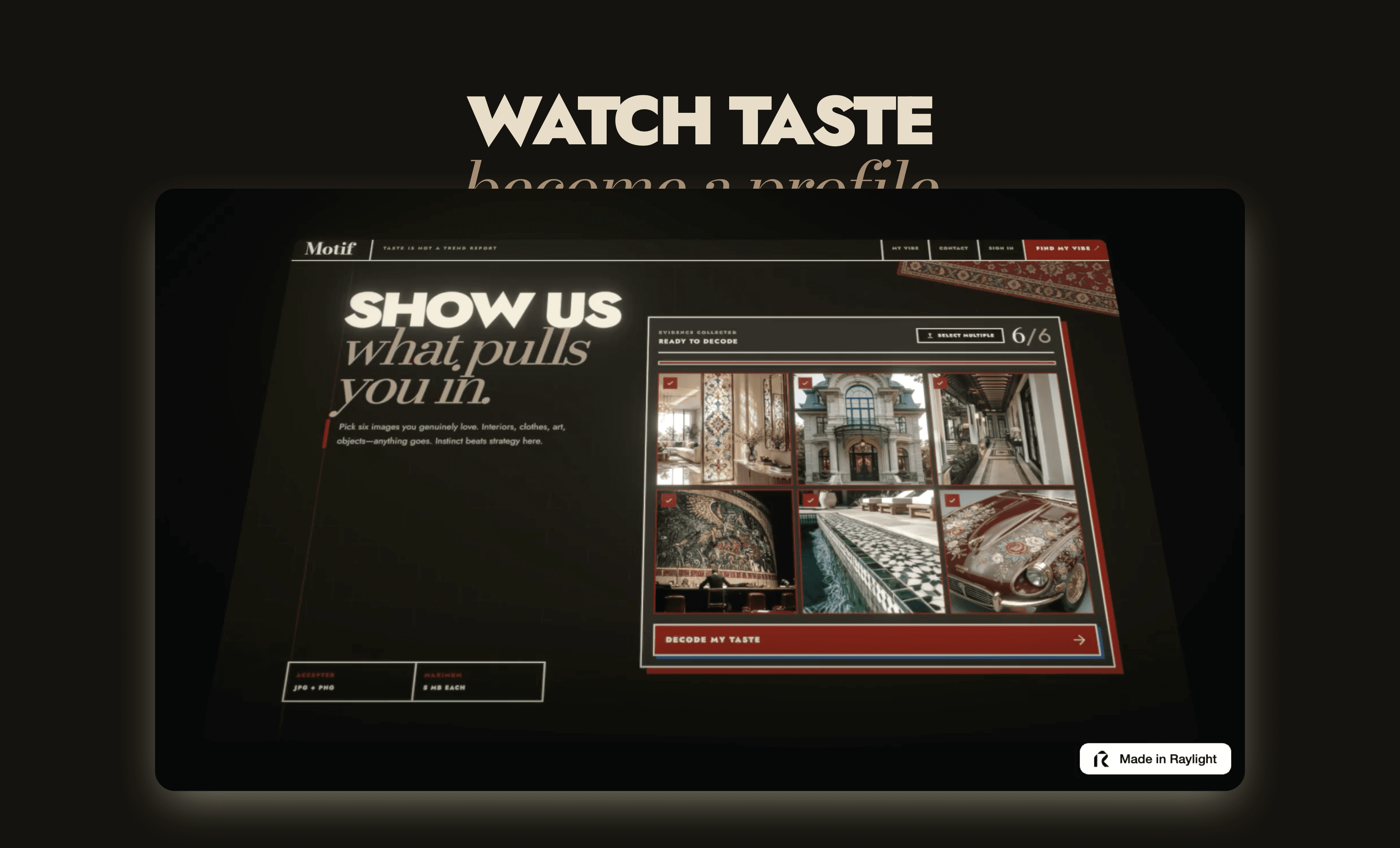
An AI aesthetic finder reads images you already love and turns that instinct into something you can name, reuse, and search with. Motif is the one I built: upload six photos, get a named vibe, color DNA, preference insights, and a private gallery of your visual evidence — then optionally shop with that profile instead of guessing keywords.
You know it when you see it. You often cannot name it. That gap is the whole product.
Watch Motif find a vibe
Drop evidence, read the shared patterns, leave with a visual taste profile you can act on. Guests get one free AI aesthetic analysis and one free search. When you are ready, start at Find my vibe.
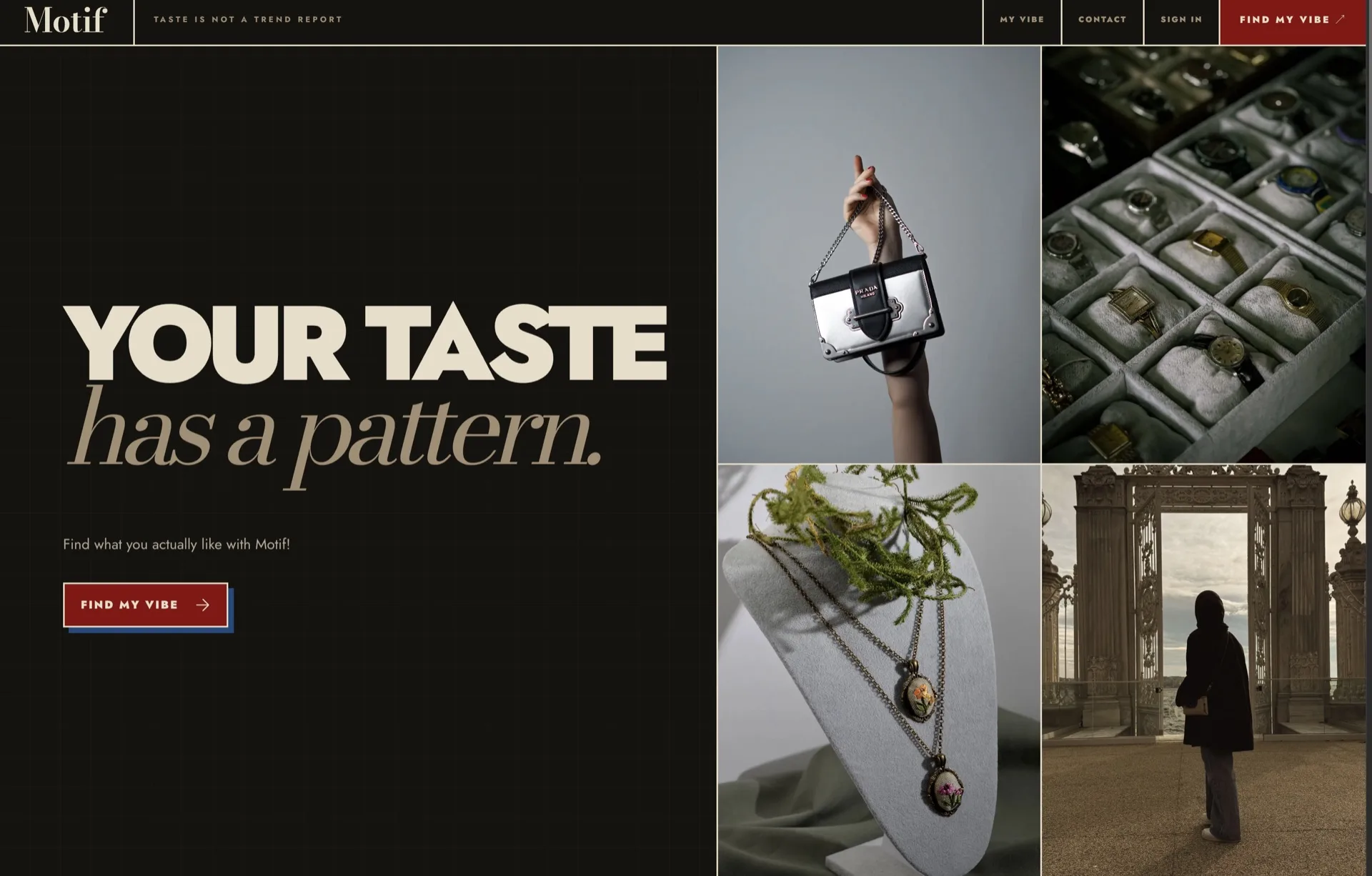
What aesthetic am I?
“What aesthetic am I?” usually sends people into quizzes. Forty questions later you get a label — cottagecore, dark academia, clean girl — that may or may not match the images you actually save at 1 a.m.
Quizzes answer personality prompts. An AI aesthetic finder answers evidence. Motif is closer to mood-board archaeology than a style quiz: you upload interiors, clothes, art, objects — anything you cannot stop looking at — and the model looks for recurring color, form, energy, and detail across the set.
That matters because most real taste is a blend. One photo might read “minimalist.” Six photos might reveal warm metal, soft contrast, and a quiet maximalism in objects that no single Tumblr tag covers. Motif names that pattern as your vibe, not as a one-size internet costume.
If you want to find my aesthetic without answering a questionnaire, start with pictures you already love. That is the honest input.
How Motif works as an AI aesthetic analyzer
Motif is deliberately tight: upload → analyze → profile → shop.
- Start Find my vibe on the editorial homepage.
- Upload exactly six JPG or PNG images (up to 5 MB each).
- Motif runs multimodal image analysis and saves a structured taste profile.
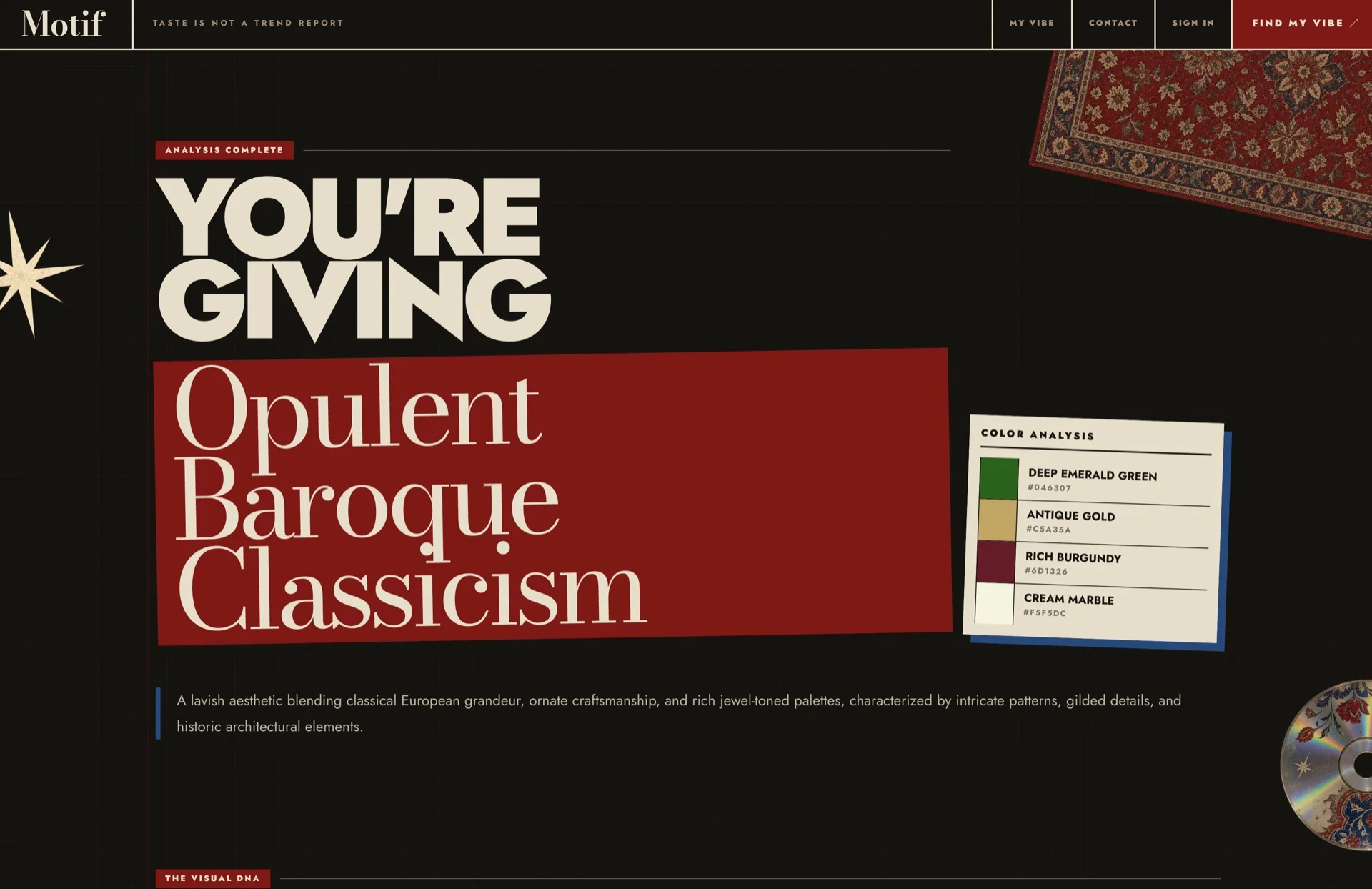
- Open My vibe — named vibe, traits, colors, insights, and your private evidence gallery.
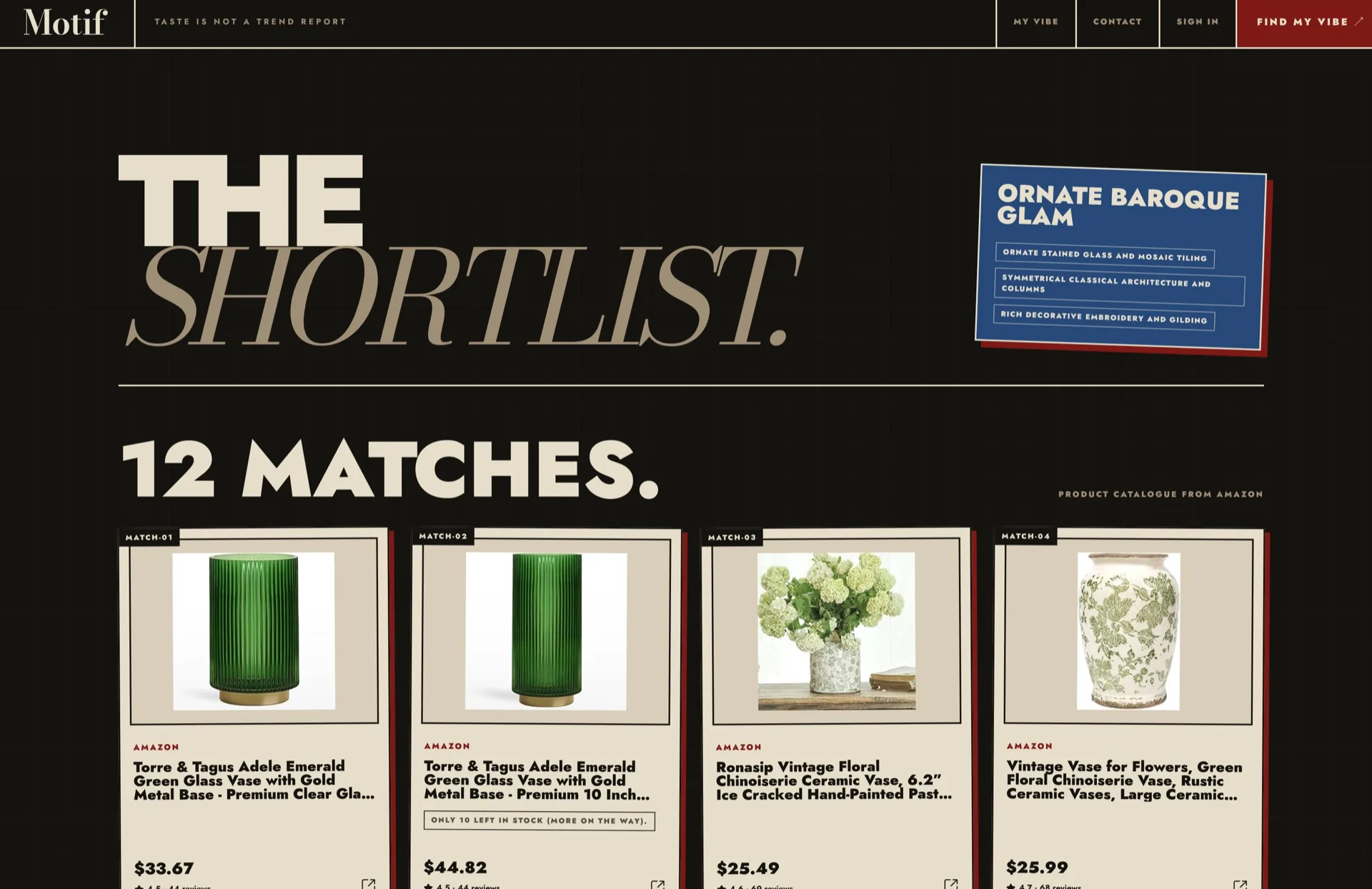
- Optionally search for an object; Motif enriches the query with your vibe, traits, and colors for taste-shaped shopping results.
Guests get one free analysis and one free search. Verified accounts unlock five of each per rolling week. Ownership can start anonymously via cookie; signing in can claim that profile so your evidence stays yours.
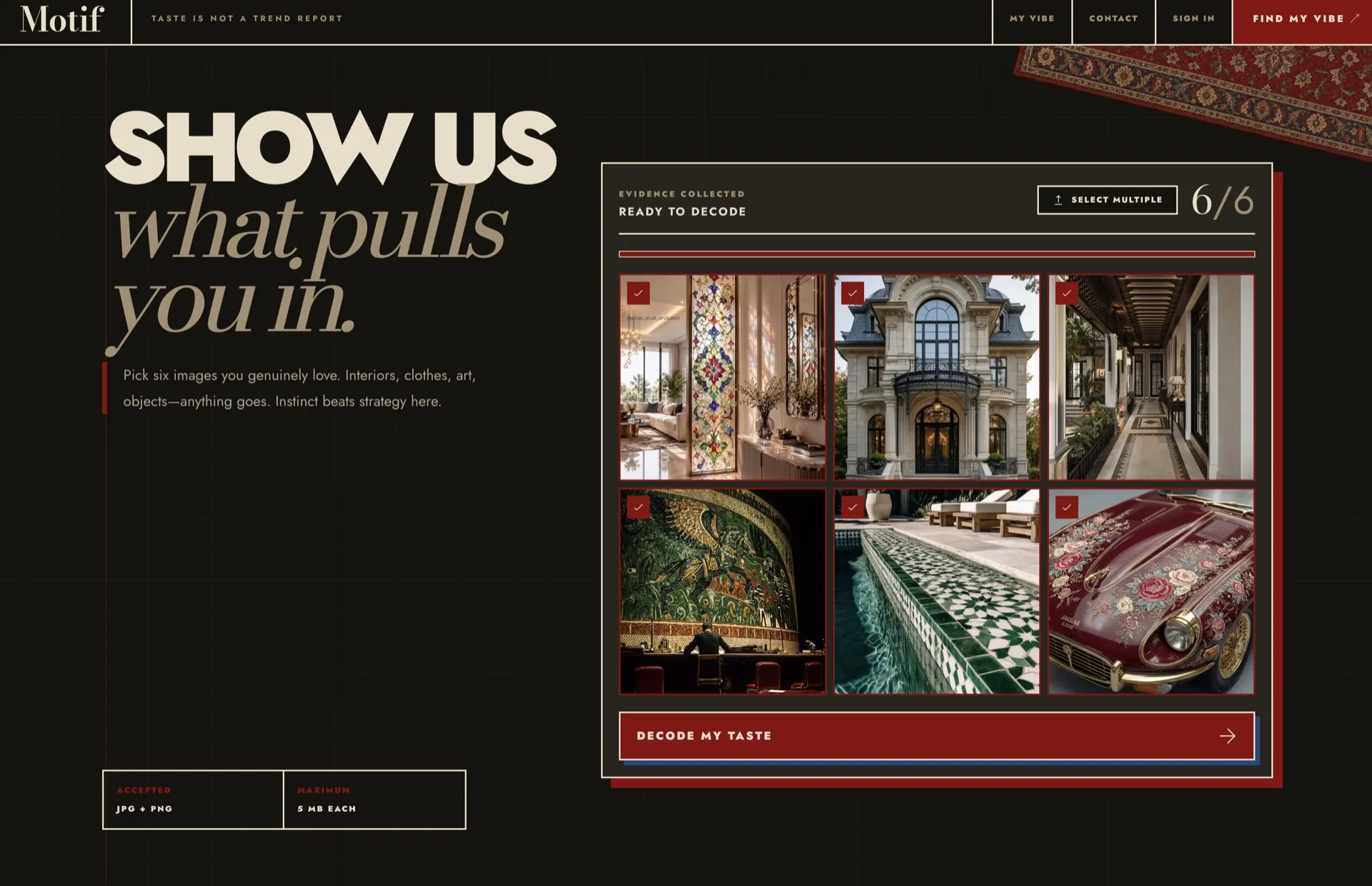
This is find-my-vibe AI in the product sense: not a chat that invents a persona from vibes-as-words, but a decoder that treats your images as visual evidence.
What you should upload
Upload six images you genuinely love — not six images you think you “should” like.
Good inputs:
- Rooms and interiors with a clear mood
- Outfits or details you keep screenshooting
- Art, objects, packaging, editorial stills
- A personal mood board flattened into six frames
Avoid:
- Six near-duplicates of the same photo
- Heavy filters that wipe color information
- Group shots or busy screenshots where the subject is unclear
- Stock “aesthetic” templates you do not actually care about
The point of an aesthetic from photos is honesty. Motif can only read patterns that are present in the set.
Aesthetic vs personal style
An aesthetic online is often a named bundle — colors, textures, props, and mood a community already tagged. Useful as a shared language. Incomplete as a map of you.
Personal style is broader: what you reach for across rooms, clothes, objects, and references when nobody is watching the algorithm. It rarely fits one tag.
Motif sits between those ideas. It will give you a named vibe (so you can talk about the pattern), but the durable asset is the visual taste profile underneath: traits, preference insights, and color DNA you can reuse for search. Think style DNA for shopping and curation, not a seasonal color analysis selfie product and not a wardrobe try-on app.
If a tool only labels a single outfit photo as “Y2K,” that is identification. If a tool builds a reusable profile from six pieces of evidence and then filters live products through that profile, that is taste you can operate with.
Color DNA from images
Motif returns color DNA — the colors your eye keeps returning to, with hex codes — plus the traits it matches against when you shop.
That is different from “you are Soft Autumn.” Seasonal systems optimize for face and fabric under lighting rules. Motif optimizes for the palette already living in the images you chose. The hex color palette from images becomes searchable language for an object query, not a wardrobe rulebook.
When people ask how to get a color palette from photos, the honest answer is: gather evidence, extract the recurring range, and keep the codes next to the vibe name. Motif packages that into the profile so you do not reverse-engineer a Pinterest board by eye every time you buy a lamp.
Shop with your taste, not just keywords
Keyword shopping fails when you cannot name the look. “Minimal vase” returns a thousand near-identical SKUs. Your visual DNA — vibe + traits + colors — narrows the field toward things that look like you.
Motif’s product search blends your profile with live Amazon results via SearchApi. You still type an object. Motif adds the taste layer. That is taste-based shopping AI without pretending Motif is a full stylist or virtual closet.
Use it when you already know the category (chair, jacket, print) but not the adjectives. The profile does the adjective work.
How I built Motif
I built Motif as a personal Next.js multimodal AI app with an editorial UI and a conversion-aware loop — not a dashboard of feature cards.
Stack in short:
| Layer | Choice |
|---|---|
| App | Next.js 16 App Router, React 19, TypeScript |
| UI | Tailwind CSS 4, custom type system, Motion |
| Auth | Auth.js (Google + email/password), JWT sessions |
| Data | Neon Serverless Postgres |
| Images | Vercel Blob (private), owner-checked API proxy |
| AI | OpenRouter multimodal chat completions |
| Shop | SearchApi Amazon Search |
| Hosting | Vercel |
Secrets stay server-side. Evidence images are never public Blob URLs. Anonymous cookie ownership can claim into an authenticated account. Consent-gated analytics and weekly allowances sit on top so guests can try the product without a wall of signup friction on first contact.
The design language is intentional: charcoal grounds, ivory type, hard borders, oversized type, red and blue accents. Editorial, not SaaS-template. Motion reveals respect prefers-reduced-motion.
I shipped it in that order for a reason: prove the taste read first, then private media and persistence, then shopping, then auth and allowances, then the public editorial homepage and launch polish. The conversion lesson was simple — let guests complete one free AI aesthetic analysis before asking for an account, then invite them when they hit the weekly wall.
If you want the portfolio write-up, architecture notes, and screenshots, see the Motif case study. Source is on GitHub.
FAQ
Can AI analyze my style from pictures?
Yes — multimodal models can read color, form, lighting, and recurring motifs across a set of images. Motif uses that for a structured profile (vibe, traits, colors, insights), not a one-line compliment.
Is there an AI that finds my vibe from a mood board?
That is Motif’s job. Treat six strong frames as a compressed mood board. The output is a named vibe plus reusable color DNA and traits.
How do I find my aesthetic with AI?
Skip the long quiz. Upload images you love, read the shared pattern, save the profile, then search objects through that taste. Start at Find my vibe.
How can I shop based on my aesthetic?
Use a profile that encodes vibe, traits, and colors, then search for the object you need. Motif enriches the query so results skew toward your visual DNA instead of generic keyword matches.
What is the difference between an aesthetic and personal style?
An aesthetic is often a named cultural look. Personal style is the pattern across everything you actually choose. Motif names a vibe for clarity and keeps the deeper visual taste profile for action.
Do I need an account for a free AI aesthetic analysis?
Guests get one free analysis and one free search. Create a verified account if you want the weekly allowance and a claimed profile.
Try Motif
If you have been hunting for an AI aesthetic finder that starts from evidence instead of a questionnaire, Motif is live.
Find my vibe — six images, one named vibe, color DNA you can shop with.
Building product UI in Next.js, or want a similar end-to-end AI loop on your own stack? Browse the Motif case study or get in touch.