
Disclosure: I build with Next.js, React, and TypeScript for a living. This comparison is still meant to be fair. Framer is genuinely good at what it does. The question is whether that matches what your SaaS landing page needs next.
Founders ask this a lot: ship the marketing site in Framer this week, or invest in a custom Next.js page that can grow into the product surface? Both can look excellent. They fail in different ways.
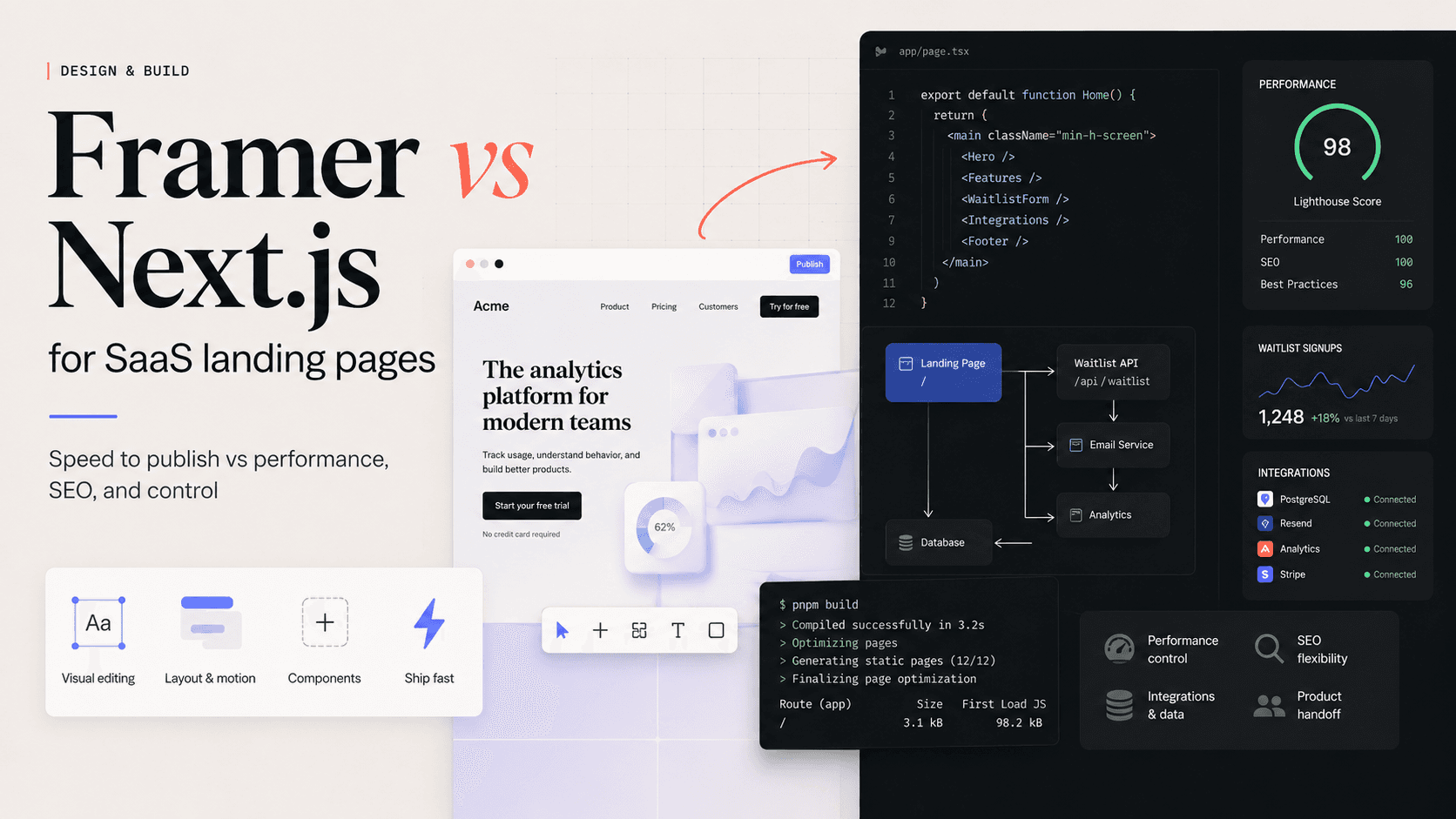
This post is a practical Framer vs Next.js breakdown for SaaS landing pages — speed to publish, performance, SEO control, waitlists, and when a hybrid setup makes sense. Pricing and platform limits change; treat feature claims as as of September 2026 and verify on each vendor’s site before you commit.
If you already chose Next.js and want conversion patterns, start with how to build a high-converting landing page with Next.js.
Quick verdict
| Situation | Lean toward |
|---|---|
| Designer-led team, need a polished page this week, little backend | Framer |
| Same domain as the app, custom waitlist, CRM hooks, programmatic pages | Next.js |
| Early brand exploration, lots of visual iteration, eng bandwidth is zero | Framer |
| Core Web Vitals are a ranking/ads problem, or you’ll A/B serious funnels in code | Next.js |
| Campaign pages now, product later | Framer now, plan a Next.js path |
Neither tool is “better” in the abstract. Framer optimizes for publish speed and designer ownership. Next.js optimizes for control and integration depth.
What each tool actually is
Framer is a visual site builder with hosting, CMS, and strong motion defaults. Designers who think in Figma can ship marketing pages without waiting on an engineering sprint. For early SaaS marketing sites under a modest page count, that speed is the product.
Next.js is a React framework. You (or your eng team) own the repo, the deploy pipeline, and every integration. A landing page can share auth, design tokens, and components with the app — or stay on a separate marketing route that’s still in the same codebase. You’re not fighting a page builder’s ceiling; you’re accepting that someone has to write and maintain code.
Feature comparison (as of September 2026)
Sources: public Framer docs/pricing pages, Next.js docs, and common production setups on Vercel or similar hosts. Numbers below are directional — run your own Lighthouse/CrUX on a real URL before arguing online.
| Criteria | Framer | Next.js (custom) |
|---|---|---|
| Time to first polished page | Hours to a few days for a strong designer | Days to weeks depending on starting point |
| Visual editing | First-class canvas | Code (or a CMS you wire yourself) |
| Performance / CWV control | Good enough for many marketing sites; ceiling is the platform runtime | Full control: RSC, caching, image pipeline, bundle splits |
| SEO basics (meta, OG, sitemap) | Solid for standard marketing pages | Full control (schema, programmatic routes, i18n, etc.) |
| Programmatic SEO (hundreds of pages from data) | Painful / manual | Natural fit |
| Waitlist + custom backend | Forms and embeds; deep logic gets awkward | Native (Server Actions, DB, auth, queues) |
| App handoff (same design system as product) | Separate world unless you rebuild | Shared components and tokens |
| Designer autonomy without eng | High | Low unless you add a CMS workflow |
| Lock-in | Platform + export limits | You own the code; hosting is swappable |
| Typical hosting cost shape | Per-site plan fees | Host + engineering time (often cheaper at scale, costlier upfront) |
Honest strengths for Framer
- Fast narrative and layout experiments without tickets
- Motion and polish that look “finished” out of the gate
- Non-engineers can update copy and sections
Honest strengths for Next.js
- Landing page and product can share one system
- You can keep JavaScript tiny (Server Components) and chase green CWV deliberately
- Waitlists, referral logic, UTM persistence, role-based dashboards — all first-class
- No surprise when marketing needs “just one more” integration
Performance and Core Web Vitals
Marketing sites live and die on first impression. Slow heroes lose paid traffic.
Framer sites can score well when you stay disciplined with images and third-party scripts. They can also get heavy when animation and embeds stack up — you’re working inside someone else’s runtime.
With Next.js you can (and should) keep most of the landing page as Server Components, ship a small client island for the form or pricing toggle, and use next/image / next/font properly. That doesn’t make Next.js automatically faster — careless "use client" everywhere will lose to a clean Framer page. It means the ceiling is higher when performance is a requirement, not a nice-to-have.
If conversion is the goal, speed is part of the conversion system. I cover the implementation side in the Next.js landing page guide.
SEO and content scale
For a handful of campaign pages, both tools can rank. The gap shows up when you need:
- Dozens or hundreds of templated pages (integrations, use cases, locations)
- Strict schema or unusual metadata rules
- Content that must stay in sync with product data
That’s where Next.js (or another code-first framework) pulls ahead. Framer’s CMS is fine for a normal marketing site; it’s not a programmatic SEO engine.
Waitlists, forms, and “marketing that becomes product”
A static brochure is easy in either tool. A validation loop — waitlist, segments, beta invites, feedback — starts to feel like product work.
I built LaunchBox around that loop: high-converting landing page, waitlist capture, testers, structured feedback. Doing that cleanly in Next.js meant the marketing surface and the operational workflows could share a stack (TypeScript, Postgres/Supabase patterns, one deploy story). In Framer you’d typically embed a form tool and accept a patchwork of vendors — fine at tiny scale, messy when the waitlist is the product.
If waitlists are your CTA, read waitlist landing page best practices for the UX side.
Team and workflow
Pick Framer when:
- A designer owns the site week to week
- Engineering is fully booked on the product
- You’re testing positioning and don’t want a repo ceremony for every headline change
Pick Next.js when:
- You already have React skills (or a frontend hire like… me)
- Marketing and product need the same components
- You’re tired of “we can’t do that in the builder”
Some teams run both: Framer for throwaway campaign pages, Next.js for the durable homepage and app. Rewrites can put Framer under a path on the same domain. That works until analytics, cookies, and SEO rules drift out of sync — document the boundary or you’ll invent a distributed systems problem for a homepage.
Cost is more than the subscription
Framer’s invoice is predictable per site. Next.js hosting on a generous free tier can look “free” until you count eng hours. Flip it for a company running many microsites: builder seats add up, while one Next.js codebase and a CMS can be cheaper over a year.
Budget for the expensive part: rework. Migrating off Framer later usually means a rebuild, not an export. Starting in Next.js slower can be cheaper if you already know you’ll need custom funnels in three months.
How I decide on a project
My personal checklist:
- Does a non-engineer need to ship layout changes without me? → Framer bias
- Is the CTA a custom waitlist or anything past a Typeform embed? → Next.js bias
- Will this share UI with an authenticated app within six months? → Next.js
- Is this a two-week brand experiment that might die? → Framer
- Are we paying for ads where LCP/INP will burn money? → Next.js with a performance budget
For my own products and client work aimed at conversion systems, I default to Next.js because I can control the full path from headline to database row. For a founder who only needs a beautiful story online this month, I won’t pretend Framer is wrong.
Migration notes (if you outgrow Framer)
Teams usually leave Framer for one of three reasons: they need custom funnel logic, they need programmatic pages, or performance/ads costs force a rebuild.
Expect a rebuild, not an export. Recreate information architecture in Next.js, move content into MDX or a CMS, and re-implement motion deliberately (often with less Motion than the Framer version had). Keep URLs stable where you can so SEO equity doesn’t reset overnight.
A pragmatic path: freeze the Framer site as the public face for two weeks while you build the Next.js equivalent behind a staging URL, then cut DNS or rewrites in one move. Don’t run two divergent brand stories for months.
Who shouldn’t use Next.js for the landing page
If nobody on the team can maintain a React repo, a Next.js landing page becomes a liability. Framer (or Webflow, or even a simple static host) is kinder than an abandoned npm project. Hire for the stack or pick the tool your team can actually update on a Tuesday afternoon.
FAQ
Can Framer replace Next.js for a full SaaS app?
No. Auth, complex state, server logic, and deep integrations are Next.js (or similar) territory. Framer is for marketing sites and lightweight content.
Can Next.js look as polished as Framer?
Yes, if you invest in design and motion deliberately. Framer makes polish easier by default; Next.js makes it intentional.
Should I rebuild my Framer site in Next.js now?
Only if you’re hitting real limits — performance, SEO scale, or integrations. Don’t rebuild for ideology.
Can I use both?
Yes. Campaign microsites in Framer, durable homepage and app in Next.js. Document which tool owns which URL path so analytics and SEO don’t drift.
What about Webflow or Carrd?
Same decision frame: builder speed vs integration depth. Carrd is fine for a single simple waitlist. Webflow sits closer to Framer for designer-led marketing. Once you need app-grade logic, you’re back in a framework.
Bottom line
Framer vs Next.js isn’t a morality contest. Use Framer when designer speed and a contained marketing site matter most. Use Next.js when the landing page is the front door to a system you own — waitlists, product UI, and long-term SEO control.
I write and ship in Next.js. If you want a conversion-focused page or a path off a builder onto a stack you control, say hello.